
The AI Isn’t Inside Your Wearable. So Why Is the Wearable Becoming Its Interface?
The intelligence may live in the cloud, but wearables are becoming the bridge between AI, your body, and the world around you.
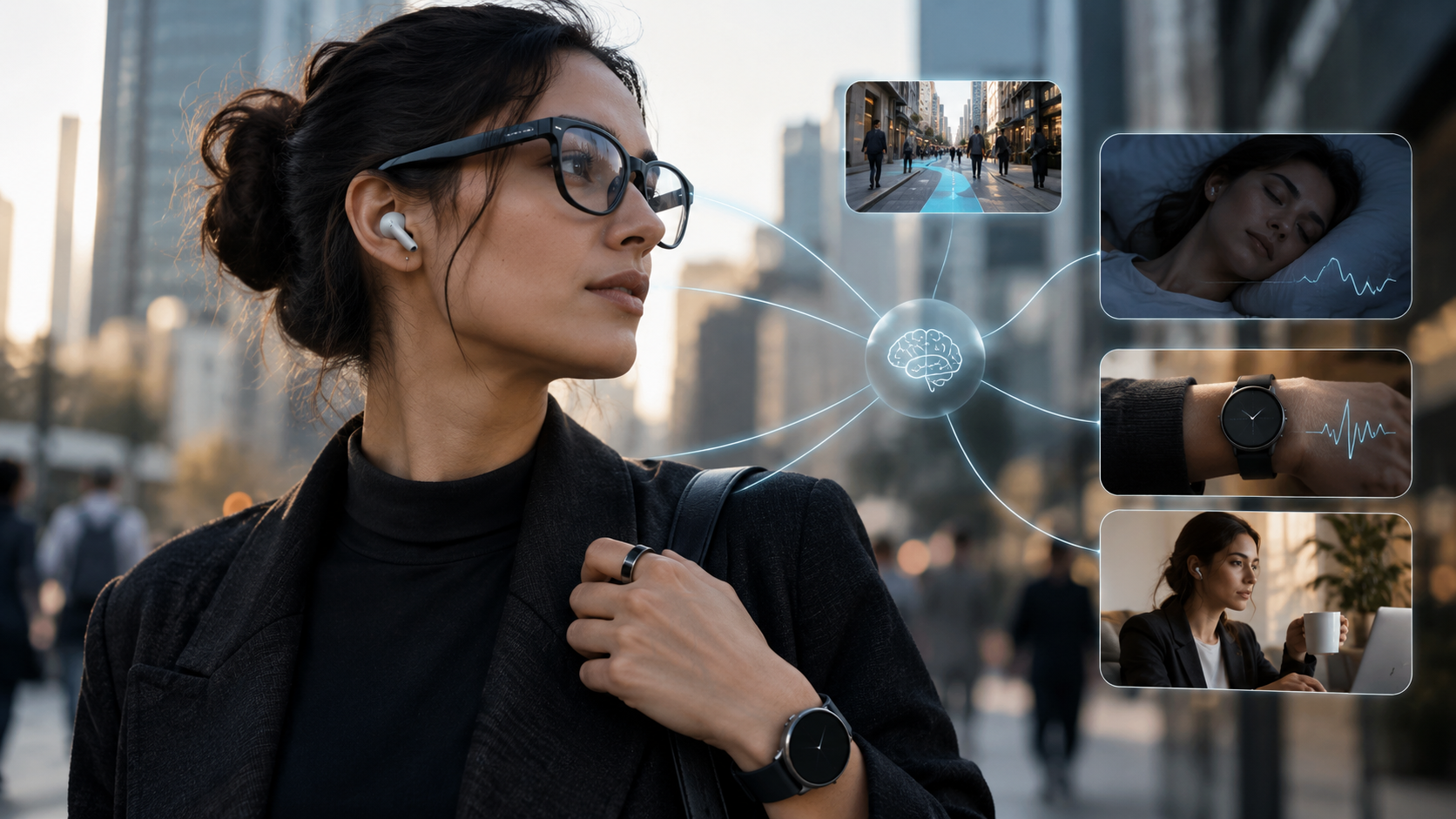
Ask an AI assistant to tell you about your day and it can only work with the information available to it. Maybe it knows what you typed. Maybe it can access your calendar, emails or other connected services if you give it permission.
But now consider a different kind of interaction. Imagine an AI system that can also receive information from the device you wear every day. A smartwatch may know that you slept poorly. A smart ring may have recorded changes in your activity or overnight patterns. Smart glasses may receive visual information from the environment around you. Earbuds can make voice interaction easier without requiring you to pick up a phone.
Suddenly, the question becomes more interesting than simply asking how intelligent the AI model is. How much does the AI actually know about the situation you are currently in?
This is one of the reasons consumer wearables are becoming increasingly important in conversations about personal AI.
The AI itself may run somewhere completely different. It could live in the cloud, work through an API, run partly on a smartphone or use a combination of local and remote processing. But the wearable sits much closer to the person using it. And that physical proximity could make it an important interface for personal AI.
The AI Doesn’t Have to Live Inside the Device
A common misconception is that a device must host a massive neural network on its local processor to qualify as an AI device.
Consider how everyday mobile architecture already functions. When you dictate a voice memo on a smartphone, the phone rarely processes the entire speech-to-text model on its internal chip. Instead, the hardware acts as an input capture node: it digitizes the acoustic waveform, streams that packet to an API endpoint over the network, waits for a remote server to complete the compute-heavy inference and receives the structured text back in milliseconds.
Consumer wearables operate on this similar client-server paradigm. The physical hardware does not need to compute hundreds of billions of parameters it merely needs to serve as the immediate sensor and feedback loop.
Consider a pair of smart glasses. The device itself captures a brief video frame of a physical object you are examining, registers your whispered question and routes both data streams through your phone to a multimodal vision model hosted in the cloud. The cloud infrastructure runs the inference and returns a short, synthesized audio answer directly to the frame's temple speakers.
The intelligence might stem from a cloud model, an external API pipeline, a connected phone running edge inference or a tiny on-device neural processing unit (NPU) handling low-power wake words. In practice, it is often a hybrid of all four.
Consequently, the physical location of the intelligence matters far less than the ergonomics of the interaction. Wearables alter how information enters and leaves the computational loop, turning data capture into a natural byproduct of simply living.
Personal AI Has a Problem: It Needs to Understand Context
The vast majority of current AI tools are inherently reactive. A person runs a program, sits in front of a prompt window, writes a complete case description and waits for a response.
This process results in high levels of cognitive friction. For receiving any useful feedback, the user needs to constantly describe their starting position: "I didn't sleep well, I had a difficult morning meeting, I already ran 4 miles today and I am tired. Should I have an intense strength workout?"
An assistant that asks for five sentences of context for each question very soon turns into administrative work. An AI tool which is connected to constant biometric data input already has all of those variables.
In a recent review of wearable intelligent human-machine interfaces, it is discussed in detail how contemporary machine learning algorithms provide that connection between raw, multi-dimensional physiological data and system actions. AI converts untidy optical and kinetic data into meaningful metrics of human condition.
Obviously, the data collected by sensors cannot be perfect, increased heart rate can result from cardio workout, sudden mental tension or merely a glass of espresso more. Telemetry does not imply full understanding of your emotions.
Still, even the simple passive telemetry makes the job of explanation a lot easier. Traditional chatbots can understand only what you want them to know, wearables can perceive all those physical facts you do not give a second thought to.
Why Screens Are a Surprisingly Bad Interface for a Personal Assistant
For the last 50 years, computing has been confined to visual interfaces. We started with desktop monitors, transitioned to laptop screens and ultimately evolved to glass screens in our pockets. Screens need visual focus, motor coordination and multi-tasking.
Opening up your phone, swiping through an array of icons, closing the notifications and opening an application creates friction. For every single interaction that needs to be done by using a slab of glass, your digital assistant is an external device and not an ambient tool.
Wearables remove this friction by being able to take advantage of existing physical space on our bodies:
Resting against the skin of your wrist
Placed inside the ear canal
Framing your field of view
Encircling a finger
Because the form factor of those devices is located right on top of the body, they become part of the ambient layer of interactions. An audio signal from the earbud or a light touch on the wrist provides the necessary information without any need to disconnect from the environment you are currently in.
The smartphone made computing portable, but wearable consumer electronics made computing ambient.
The Most Valuable Thing a Wearable Provides Isn't Intelligence: It's Proximity
Smartphones are undoubtedly personal devices, but they spend significant portions of the day resting on desks, tucked away inside backpacks or charging across the room. Consumer wearables, by contrast, maintain uninterrupted physical contact with your body. That physical proximity changes the fundamental quality of the data being captured.
Different wearable form factors provide distinct contextual signals:
Form Factor | Primary Physical Placement | Contextual Signals Collected | Primary Output Mechanism |
Smartwatch | Dorsal wrist | Continuous photoplethysmography (PPG), skin temperature, accelerometer motion | Visual display, haptic vibration |
Smart Ring | Proximal finger phalanx | High-fidelity pulse transit metrics, nocturnal sleep stages, baseline temperature | Ambient app sync, subtle status LED/haptic |
Smart Glasses | Facial bridge/temples | First-person visual scene capture, head orientation, spatial audio inputs | Open-ear audio, optical micro-HUD |
Wireless Earbuds | External ear canal | Directional voice pickup, in-ear biometrics, acoustic environment profiles | Spatial audio, direct voice feedback |
Studies done on context-aware Augmented Reality systems show that there needs to be a combination of environmental sensors with behavioral tracking sensors in order to have a seamless experience.
The more the AI has access to not only the physiological signals from the wrist but also the visual signals from the glasses, the better it will be at understanding the tasks at hand.
However, proximity to the skin has two sides to it. The nearer the sensors get to the skin, the more vulnerable the collected signals become.
From "Ask Me Anything" to "Help Me at the Right Moment"
However, the standard way of operating artificial intelligence is the query-and-answer approach where the person sends a message and the server replies with some text. But such an assistant, which responds to queries only, is just an automated help desk.
Think about how this impacts everyday situations:
Navigating the City: Rather than forcing you to stare down at your phone map while walking through an intersection, your connected wearable vibrates on the left side of your wrist and whispers, “Turn left at the next intersection after the crosswalk.”
Physiological Load: Rather than just displaying your 118 BPM heart rate on its own, the smart layer makes correlations with other factors, like calendar entries and activity. It understands that you are seated in a scheduled presentation and thus correctly interprets the high pulse rate as nervousness and not cardiovascular exercise.
Communication Filtering: As you receive a message, your device notes that you are walking on a busy street using earbuds. In that case, it doesn’t bother with vibrations but reads out a succinct two-sentence summary of the message and filters any non-essential notifications until the meeting is over.
None of these examples have anything to do with medical diagnostics, but it’s all about contextual filtering. A personal assistant is not there to answer every conceivable question, but to understand when an intervention makes sense.
The Real Shift Is From Apps to an AI Layer
Modern operating systems force users to act as manual software integrators. If you plan an evening out, you must jump across separate apps: one for text messaging, another for calendar entries, a third for navigation and a fourth for streaming audio.
Wearables accelerate the transition from siloed applications to a unified conversational agent layer. An extensive study in the Intelligent Personal Assistants: A Systematic Literature Review emphasizes that natural language and multimodal interfaces succeed by translating human intentions into background system actions across external endpoints.
Rather than opening an app to adjust a schedule, a wearer can murmur to an ear-worn interface: "Let Sarah know I'm running ten minutes late and adjust my evening reminders."
But "Personal" Can Quickly Become "Too Personal"
Since consumer wearables collect data through skin contact, the stream of collected data is unique in its intimacy. The data stream of the wearable interface shows the places where you look, the times when your heartbeat accelerates, your sleep interruptions and your daily geographical path.
The research article on privacy, ethics, transparency and accountability in AI wearables states that there are serious vulnerabilities in user consent, algorithmic biases and data monetization by third parties since the collection of continuous biometrics occurs.
There are some architectural concerns that arise when continuous biometrics are sent to third-party APIs:
Where are the telemetry stored and for how long?
Is it possible to permanently remove your physiological telemetry from the datasets used for training remote models?
Is it possible for the AI assistant to give information about the telemetry that caused the behavioral recommendation?
What prevents health data from being re-packaged as behavioral advertising profiles?
Anxiety plays a significant role in consumer acceptance. Empirical studies on the acceptability of intelligent glasses have shown that even though intelligence and visual ergonomics help in adoption, privacy issues continue to be a significant barrier.
The nearer the intelligent interface is to the human body, the greater the need for proof of data ownership and governance.
Wearables Could Give AI Something Phones Cannot
Even today's highly advanced phones are constrained by physical attributes that limit them from offering true frictionless context-aware assistance. The phone that sits in your pocket or even in a face-down position on your nightstand is incapable of understanding your posture, gaze and acute physiological changes.
There are four basic primitives that wearables bring to the table, which a smartphone cannot replicate:
Presence: Wearables stay connected with the body for several days or weeks continuously and hence can establish continuous baseline patterns rather than discrete snapshots.
Somatic Context: They record heart rate variability, skin temperature and micro-movements during sleep and map them to biological state to make those inputs usable.
Frictionless Interaction: A simple tap, head tilt and voice commands help them overcome the friction involved in waking up a mobile device screen.
Environmental Alignment: Eyewear and open-ear devices sense the physical environment in the exact same alignment as the user does.
Compute may reside on the remote server, but the wearables give the physical presence in real world, without which that compute remains irrelevant.
The Future Might Not Be "Always-On AI"
Common representations of wearable AI tend to show an omnipresent system that constantly observes, analyzes and intervenes at every single moment of everyday life. In real life, however, constant passive surveillance is both socially alienating and mentally draining.
A paper studying episodic assistance in ear-worn interfaces found that always-on devices create significant surveillance anxiety for both the wearer and nearby individuals. It was discovered that the users greatly preferred explicit and intentional boundaries like ritualistic activation processes and physical reminders over always-on tracking and observation.
The future of ambient intelligence does not lie in a device that observes your whole life uninterrupted. Rather, it lies in an environment of intentional, episodic use:
Physical switches and clear hardware-based privacy shutters
Local LED indicators informing bystanders about the state of the sensors
Edge processing, which discards any raw audio and video data immediately after local feature computation
Contextual wake-up routines that demand explicit user intention before sending packets through the network
Elegant engineering consists of building an assistant that knows just enough to be helpful upon being summoned and does not do anything otherwise.
So, Why Are Wearables Becoming the Interface for Personal AI?
Wearables are establishing themselves as the go-to interface for personal artificial intelligence as they exist precisely at the intersection between your body, your immediate surroundings and your digital infrastructure.
The intelligent aspect is going to continue being decentralized among cloud servers and APIs. However, a language model on a remote server cluster cannot intrinsically have knowledge of your tiredness, your rush and the street corner where you are standing.
The intelligence of contemporary artificial intelligence can be shared among millions of concurrent users. The context which makes it personal cannot.
Your nightly sleep pattern, your baseline physiological state, your surroundings and your movement are uniquely yours. Wearables are going to become important not as they create the intelligence, but as they collect the context making the intelligence personal.
The next big interface for artificial intelligence is not going to be an application, a browser window or even a pane of glass. It is going to be the hardware you are wearing.
Wrap Up
While wearables might not be where all the artificial intelligence will live in the future, they could very well be where all the AI intelligence is experienced the most naturally. The reason being that by sticking closer to our physicality and surroundings, wearables have an opportunity to give AI the necessary context needed to make it more personalized.
What we really need today is not just a more intelligent AI system. What we need is a more practical, private and human one.


